


Ben Lindley, Company Director at Japanese Knotweed Ltd. Last reviewed on 15th October 2026.
We often get asked if it’s possible to kill Japanese knotweed, how to permanently destroy Japanese knotweed or if you can treat knotweed yourself. The answer is knotweed cannot be ‘killed’ it can only be controlled or removed from site to a landfill centre licensed to receive noxious waste. Sadly for budget conscious homeowners, DIY is not a viable solution. Due to complex legal issues around knotweed spread and disposal, it could land you with a hefty fine. Japanese knotweed cannot be disposed of by binning, tipping or burning – it is ILLEGAL.
The reason Japanese Knotweed Ltd is a member of several professional trade bodies such as the Property Care Association, is so we can assure our clients that our knotweed works are carried out under full legislative compliance. We also guarantee our work with an insurance policy, accepted by estate agents, surveys and mortgage lenders.
Let’s explore the correct Japanese knotweed treatment options in more detail.
Herbicide Treatment
Herbicide treatment of Japanese knotweed is the least invasive option but does require several planned treatment visits a year – for up to 10 years. Each treatment application will control the plant’s growth, until it eventually reaches a dormant state. Visits are scheduled in at times of the year for optimum efficacy of the herbicide.
The two main methods of Japanese knotweed herbicide treatment are stem injection and foliage spraying. Take a look at these knotweed treatment methods in the photos below.

Stem injecting Japanese knotweed with herbicide
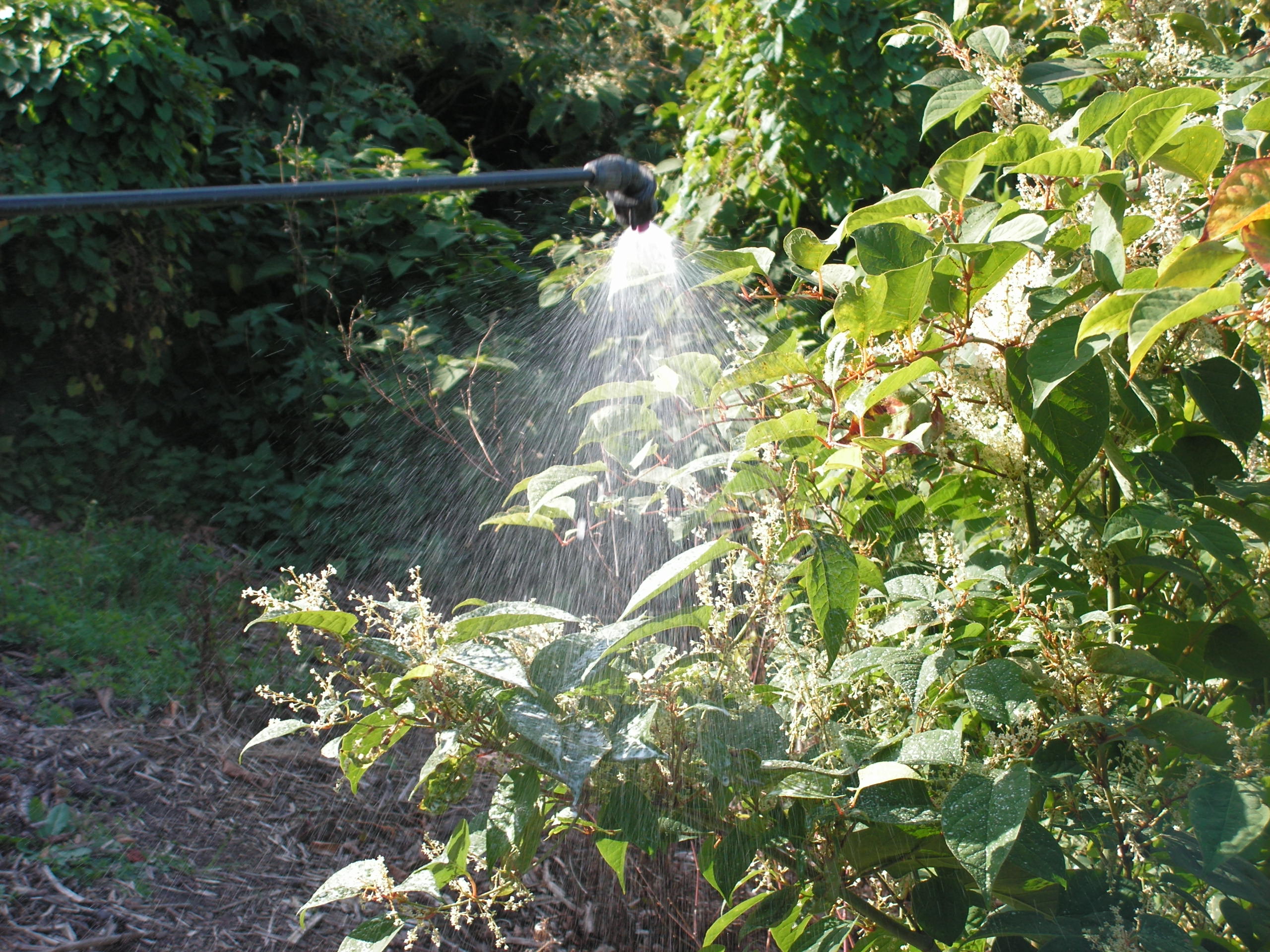
Spraying Japanese knotweed foliage with herbicide
Excavation and removal
The only real way to get rid of knotweed is to by mechanical method – digging it up. You could do this by hand, but an excavator is usually required, plus there’s the license to take the waste soils off site to a licensed landfill to comply with government legislation. The important thing here is that all fragments of knotweed must be removed as even a tiny piece of rhizome root left in the ground will create a new plant – and you’re back to the initial issue of having knotweed in the ground.

Commercial excavation

Residential excavation
Brush cut of stems
Knotweed canes can be cut down at the end of the growing season (called brush-cutting). Whilst this will remove the vegetation above ground, it does not affect the below ground rhizome root systems which are the power house of the knotweed plant.
With these still intact underground, come the new growing season they will sprout new shoots. However, brush cutting the canes does allow for easier treatment or excavation, and is a popular method for preparing the ground for either option.

Winter canes can be cut down ready for next season treatment or excavation.
Biological control
There isn’t really any effective method of biological control. There is a psyllid native to Japan that can be used to control Japanese, giant, and Bohemian knotweeds. The insects feed on the leaves and stems of knotweed by removing sap with its mouthparts. However this merely reduces the above ground parts of the plant, so comes with the same issue as brush cutting.
Summary
There are really only two effective methods of killing (or getting rid of) knotweed, and they are by controlling it (with herbicides) or digging it up and removing from site. To get the ball rolling we recommend a survey – this will provide you with accurate findings of knotweed (or not) and the extent of knotweed you’ve got to deal with. We can help with that – our teams are local to you.